It is amazing, the cost of Health Care, Insurance, Energy, Automobiles, and Banking. The money spent by these industries to buy off the government is out right crazy. And who gets to pay for these costs? The Consumer does. Not only does the consumer pay by rules and laws or regulations that are implemented to benefit the businesses like credit card rates and predatory lending, the companies also pass this expense on to the customer in higher prices for their product to squeeze out that extra profit after their overhead expenses are paid off. And then After the companies get all the breaks we get to bail them out so we can be further abused and ripped off.
What would Health care cost if $1,688,005,232 for Pharma and Health Care products, $1,269,279,506 for Insurance companies, $669,985,584,for Health Professionals, $747,761,294 for Nursing homes and Hospitals lobbying funds was not spent but instead funneled back into the companies, Health Care providers, Pharma etc.. ?
What would cars cost if $547,647,406 from the Automobile industry, $834,166,456 from Oil and Gas industry for Lobbying was instead invested back in the product.
Washington is owned by the industry and as long as there is lobbying there really can't be reform, at least not reform that benefits the general public. The Health Care debate is turning out to perfectly illustrate this and how corrupted our government has become.
If this is supposed to be a Free Market, Capitalistic society let the markets decide what can be supported not the lobbies and Government deals that artificially keep unprofitable business practices in profits with special deals, incentives and loopholes and bailouts. It is time for the government to get back to what it was meant to do. Represent "We The People" not We the Corporation! It is time for Corporate America to come back to reality and make an honest buck on it's own and pay its CEO's a reasonable income package it can afford.
Here is what is spent from 1998-2009 for the top 20
Industry
Total
Pharmaceuticals/Health Products
$1,688,005,232
Insurance
$1,269,279,506
Electric Utilities
$1,161,001,787
Computers/Internet
$955,361,777
Business Associations
$871,366,563
Oil & Gas
$834,166,456
Education
$815,729,134
Real Estate
$766,216,631
Misc Manufacturing & Distributing
$757,599,282
Hospitals/Nursing Homes
$747,761,294
Health Professionals
$669,985,584
Securities & Investment
$653,495,355
Civil Servants/Public Officials
$641,701,230
TV/Movies/Music
$640,809,522
Air Transport
$636,212,920
Misc Issues
$562,792,892
Telephone Utilities
$556,720,220
Automotive
$547,647,406
Telecom Services & Equipment
$524,760,039
Defense Aerospace
$447,559,402
Open Secrets Lobby Database
Sep 15, 2009
Jul 2, 2009
Unions and Government workers
It fries me to no end to hear people trash unions, Federal, State, County, City workers.
Lets start with unions. Does anybody remember the labor strikes, the sweat shops, the labor standards before unions. Did they live it or just sleep through the lessons in junior high.
I for one am glad that with Unions in the country we have safe working conditions, healthy work environments and can make a living to support a family. We can have , For what it is worth now health insurance and other benefits. Unions pave the way for non-union jobs and employers to provide for their employees in order to remain competitive.
Without unions this country would not have grown. Without unions this country would be just as China, Mexico and India are today, abusing their workers for the bottom lowest dollar, unsafe conditions, no health benefits and a total lack of environmental concerns. So next time you piss and moan about unions stop and look what they have done for you whether you are in a union or not. You have reaped the benefits. Or you could live in China,India or Mexico or some other abused third world country.
SO with that rant I move on to the government workers,and taxes. If you hate taxes and taxes paying government workers.
Stay off my roads, sidewalks, highways bridges. Stay out of my parks, off my lakes and rivers. Stay off my trains and runways and out of my airports. Stay out of my hospitals, schools and colleges and universities. Stay out of my museums and cultural attractions. Don't ask for unemployment or welfare benefits, don't ask for defense,(military or National Guard), don't ask for police, fire or emergency services.
Don't ask to be heard fairly in court. Don't ask to get custody of your kids.
Don't expect to have a library to go to to get a book or help you get a job.
Don't expect your drivers, fishing or hunting license to be renewed. Don't expect your food to be safe. Don't expect roads to be plowed, bridges maintained and roads repaired.
Your house? Don't bath shower or flush the toilet, Don't forget that clean water and sewage service is provided by your government. It's nice your house is safe and meets building codes, and it was inspected by whom? What are you gonna do with your trash, guess you will have to burn it, If you can get a garbage burning permit. The second you step out of that house, you are dependent on some government worker to maintain the roads, services and functions you depend on and use every day for work or play or to attend your needs. I guess you get what you pay for and if you don't pay taxes and think the workers don't deserve a pay. Well I guess you need to find a hole to live in that does not provide you any of the benefits. You might find one in some third world country where no one cars if you live or die just as long as they make a buck of you first.


May 17, 2009
Another Rant on the Economy
In a Free Market sustainable market prices would be kept in check or sustained by supply and demand. High prices out of reason would not be sustainable nor would unprofitable low prices.
Properly run companies with sound business models and desired products survive and thrive.
Free Market has been skewed and no longer functions in our society
Walmart at one time was a company that was known for selling products made in the USA. They have been forced to change due to their own corporate strategies. To guarantee the lowest prices they force manufactures to provide product at their lowest terms. To risk losing out on the massive world market shares that Walmart demands the companies have to cut costs. Many US companies have gone out of business or sent operations abroad. The US workers have lost their jobs. Many companies no longer see a healthy profit margin.
The US Auto Industry has not listened to consumers or lessons from the 70s fuel shortages.
Instead of researching and developing new technologies, smaller or more fuel efficient vehicles they have lobbied the government to stall change and continued to produce large or fuel consuming vehicles. The markets have now changed and they have no product that the consumer wants.
The Banking industry has come to run the country (into the Ground). They have run rampant with regulations removed and no checks and balances and corrupt practices. They now hold the countries hostage to big to fail or collapse. They fueled and provided the Housing bust and now in the next wave the Credit bust. All from giving credit where credit should not have been given. Instead of providing a guaranteed fixed rate and guaranteed income they have both in the housing market and now the Credit Card industry changed terms and rates on customers forcing those that can't pay to default.
They have come to depend on those that they screw over to bail them out. And in return they want to continue stiffing their customer.
Business models no longer work for the best product at a sustainable or profitable cost for the customer where profits go back into the company, its employees, expansion, research and development.
Now the profits go to the executives, stock holders and profits are determined by getting the highest price for the product at the least expense. The cost reductions are made by sending production abroad to avoid pollution requirements, labor laws and use tax loopholes. Again more workers in the US lose their jobs.
Health Care has been choking the economy to a slow death. Our health care system is also run like the banks and Wallmart. They control everything with the bottom line of Profit to executives and Stock Holders. Profits are attained by higher rates and denying coverage. Pay out as little as possible, collect as much as you can. The costs now are the number one problem with companies in financial problems trying to provide workers healthcare. People are going bankrupt because of the Health care industry.
Unions have been blamed for the problems as well with the benefit packages they garner.
All I can say about unions is throughout the history of US labor the benefits won by unions carry over and help the non union labor markets. They bring a level that non unionized companies have to strive to compete with. Without unions we would still be seeing the abuses of labor, poor wages, and no health care through all sectors of the job market without unions
Greed has been the driving factor through all assets of industry and finance and health care. It is not free markets. The companies lobby the government and receive breaks and perks to benefit their business but the people do not get represented. Greed has sent the jobs abroad and shut down manufacturing. Income has stagnated. The Middle class can no longer sustain the economy, they can no longer afford to purchase products, they can no longer get credit. The very industries, financial systems and banks that abused the middle class continue to expect the middle class to bail them out but are unwilling to change or help the middle class.
The banks continue to raise interest rates to customers at the same time that the customers /taxpayers are paying their bailout.
GM also bailed out by taxpayers are returning the favor by eliminating tens of thousands of workers, their benefits and pensions and announces they will be moving production to China.
So when is Industry, The Financial Sectors, and Government going to figure it out. Quit pointing fingers as to what administration is responsible. Quit fucking over the middle class. With out them you can't survive. You are doing everything to make sure the middle class will not survive. There are no profit margins or stock options to pay your dividends without the middle class.
You have told your customer base to go f... yourself. What are you going to do to get that base to return.
May 14, 2009
Calling Mr Atoz, You are needed
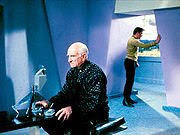
I was looking at the Taiga Forum and thought of the Library and Librarian Mr. Altoz, in the Star Trek Episode " All our Yesterdays." The libary is empty except for Mr Atoz. It is just rows and rows of discs that can be viewed on a viewer before jumping through the Portal.
1. ... all librarians will be expected to take personal responsibility for their own professional
development; each of us will evolve or die. Budget pressures will force administrators to
confront the "psychological shadow" cast by tenure and pseudo-tenure that has inhibited
them from performing meaningful evaluations and taking necessary personnel actions.
Librarians who do not produce will be reassigned or fired.
2. ... collection development as we now know it will cease to exist as selection of library
materials will be entirely patron-initiated. Ownership of materials will be limited to what is
actively used. The only collection development activities involving librarians will be
competition over special collections and archives.
3. ... Google will meet virtually all information needs for both students and researchers.
Publishers will use Google as a portal to an increasing array of content and services that
disintermediate libraries. All bibliographic data, excepting what libraries create for local
special collections, will be produced and consumed at the network level.
4. ... knowledge management will be identified as a critical need on campus and will be
defined much more broadly than libraries have defined it. The front door for all
information inquiries will be at the university level. Libraries will have a small information
service role.
5. ... libraries will have given up on the "outreach librarian" model after faculty persistently
show no interest in it. Successful libraries will have identified shared goals with teaching
faculty and adapted themselves to work at the intersection of librarianship, information
technology and instructional technology.
6. ... libraries will provide no in-person services. All services (reference, circulation,
instruction, etc.) will be unmediated and supported by technology.
7. ... libraries will have abandoned the hybrid model to focus exclusively on electronic
collections, with limited investments in managing shared print archives. Local unique
collections will be funded only by donor contributions.
8. ... library buildings will no longer house collections and will become campus community
centers that function as part of the student services sector. Campus business offices will
manage license and acquisition of digital content. These changes will lead campus
administrators to align libraries with the administrative rather than the academic side of
the organization.
9. ... the library community will insist on a better return on investment for membership
organizations (e.g., CRL, DLF, CNI, SPARC, ARL, ALA). All collaboration of significance will
be centered around either individual entrepreneurial libraries (e.g., HathiTrust, OLE), or
regional consortia.
10. ... 20% of the ARL library directors will have retired. University administrators will see
that librarians do not have the skills they need and will hire leaders from other parts of the
academy, leading both to a realignment of the library within the university and to the
decline of the library profession.

What is the Taiga Forum? It is a community of librarians working at the Assistant/Associate University Librarian (AUL) and Assistant/Associate Director (AD) levels that are challenging the traditional boundaries of libraries. Vision and forward thinking is great but this group is just plain out whacked. I have heard of out in left field but they are not even in the field.
Their Vision or five year plan is summed up in their Taiga 4 Provocative Statements from Feb 20, 2009.
1. ... all librarians will be expected to take personal responsibility for their own professional
development; each of us will evolve or die. Budget pressures will force administrators to
confront the "psychological shadow" cast by tenure and pseudo-tenure that has inhibited
them from performing meaningful evaluations and taking necessary personnel actions.
Librarians who do not produce will be reassigned or fired.
Ok, This one isn't too Bad Of course people need to learn the new technology. Produce or get fired ? I guess that works just as good as bonuses or other incentives to get results but I can't say it is a morale boosting technique.
2. ... collection development as we now know it will cease to exist as selection of library
materials will be entirely patron-initiated. Ownership of materials will be limited to what is
actively used. The only collection development activities involving librarians will be
competition over special collections and archives.
Whatever, Why not let the Booksellers do it completely for the library,that way you can be sure that they clear the stuff off their shelves that won't sell.
3. ... Google will meet virtually all information needs for both students and researchers.
Publishers will use Google as a portal to an increasing array of content and services that
disintermediate libraries. All bibliographic data, excepting what libraries create for local
special collections, will be produced and consumed at the network level.
For some reason this one was crossed out. I Don't know if that's because they feel it is completed or just a joke. Glad we can get rid of all those useless other Databases and Catalogs and Google everything.
4. ... knowledge management will be identified as a critical need on campus and will be
defined much more broadly than libraries have defined it. The front door for all
information inquiries will be at the university level. Libraries will have a small information
service role.
Knowledge needed on Campus ? How Ironic, too bad they feel a need to manage it. I guess this puts the public libraries out of business.
5. ... libraries will have given up on the "outreach librarian" model after faculty persistently
show no interest in it. Successful libraries will have identified shared goals with teaching
faculty and adapted themselves to work at the intersection of librarianship, information
technology and instructional technology.
Yup those homebound people, nursing homes and prisons are such a drag to bother with it will be so nice to know that successful libraries say to hell with special needs.
6. ... libraries will provide no in-person services. All services (reference, circulation,
instruction, etc.) will be unmediated and supported by technology.
Calling Mr Atoz , You are needed at the desk someone just jumped through the Portal.
7. ... libraries will have abandoned the hybrid model to focus exclusively on electronic
collections, with limited investments in managing shared print archives. Local unique
collections will be funded only by donor contributions.
What they are saying "Local Unique collections", What they mean is "Books and printed materials"
8. ... library buildings will no longer house collections and will become campus community
centers that function as part of the student services sector. Campus business offices will
manage license and acquisition of digital content. These changes will lead campus
administrators to align libraries with the administrative rather than the academic side of
the organization.
Thats right they got rid of the "Local Unique collections" because the donors lost their money to Madoff.
9. ... the library community will insist on a better return on investment for membership
organizations (e.g., CRL, DLF, CNI, SPARC, ARL, ALA). All collaboration of significance will
be centered around either individual entrepreneurial libraries (e.g., HathiTrust, OLE), or
regional consortia.
Or, they will do away with idiotic organizations and manifestos such as this and get back to real library work.
10. ... 20% of the ARL library directors will have retired. University administrators will see
that librarians do not have the skills they need and will hire leaders from other parts of the
academy, leading both to a realignment of the library within the university and to the
decline of the library profession.
Well this will be one way of getting rid of these high paid clueless administrators who thought up this garbage. Oh Shit now what do we do Mr Atoz has jumped through the portal also.
-
I thought some of the those interviewed in the piece Librarian 2.0--Interviews of the future of librarians were a bit out of touch with their visions and and too wrapped up in techno - lust but this group sets a whole new level of OUT OF TOUCH WITH REALITY.
May 6, 2009
Media Lab in Retrospect
I thought I would do a little retrospective look at the Media lab.
This is not the well known Media Lab at MIT but still widely known throughout the library world. In 1973 some innovative thinkers created the Library Media lab. It was just a small room that the library patrons could use to make movies and slide shows, use a darkroom or check out camera equipment. The Media Lab continued to grow and after 22 years it offered to the library patron, 2 photo Darkrooms, a sound proof recording booth and Audio Production station, Audio and Video tape duplicating including international standards, Film and Slide to video transfer, Photo copy tables and slide show production. In addition to in house services the media lab checked out Video and Film Cameras, Slide projectors and dissolve units, Photo Lighting Kits, Microphones mixers and Multi-track recorders. Media Lab Staff, I became one of them in 1984, were there to assist and train the patrons in producing their projects and also instructed occasional workshops in Photography and archiving photos. The media Lab was part of the Library AV department that included a TV production studio that produced several library programs for Cable Television and was a community access center for Cable production.
In 1996 nonlinear video editing and Apple computers for graphic production were set to be added to the Media labs capabilities along with the newer 8mm video cameras and equipment to replace the older VHS units. The Labs Video capability included Beta, VHS, 3/4, 8mm, Pal /Secam/NTSC conversion and film/slide/photo to video conversion.
In 1995 the use of the lab was over 10,000 patrons a year and growing.
In 1995 citing budgets and a view that cable was no longer viable the AV department was shut down entirely. Most of the Cable studio was sold off to the local cable companies and most of the Media Lab went to the Edina Art Center and the library no longer had any AV department, Cable TV production or Media Lab. It was a very controversial closing as noted by the local newspaper and the ALA American Libraries.
Now it is 2009, almost a full 14 years since it was shut down. I just completed the second round of the 23 things on a Stick and learning about Library 2.0 applications.
The Edina Art center has continued to thrive and expand to include the Peggy Kelly Media Arts Center from where the Media Lab left off.
In the library world the push for 2.0 uses the methods for producing and sharing documents, Videos, Photos grows more prevalent every day. The Media Lab was in essence providing what the current technology allowed it to do. It turns out it was exactly what the Library World is screaming to provide today. The Media Lab was set to be among the first in libraries in the country to offer a computer lab, with the closing it took another 10 years for the library to reach that point.
In many ways when the library eliminated the AV department the library fell behind. Instead of AV being the backbone of what and how the library was used outside of traditional book services these services were delayed until the libraries came online and had a robust enough network. The Library was itself transforming from a printed catalog to an online catalog at the time of the close. It has been only within the last several years that the online functionality has been able to support and provide the Web 2.0 needs.
I am amazed at the irony of how what was once a unique and trendy lab that visitors from around the world visited was closed and now the very services it offered are what is now in demand with the 2.0 needs. It is amazing how a simple decision can affect things down the road. It is a dynamic illustration of decision making. I can only imagine what we would be offering our patrons today had the decision reflected forward thinking that took into account the customers and staff wishes over a simple budgetary cut.
The Aarhus Library in Denmark now has The Transformation Lab that has produced new visions for the physical library of the future. I saw real similar foundations between what the Media lab was and what the Transformation Lab does. It is very possible that had the Media Lab been allowed to remain it too would be offering this type of function as an integral part of the library.
Subscribe to:
Posts (Atom)